

Enrique Lores has completed his second quarter as CEO and the market’s reaction to the beat and raise narrative suggests relief. Branded Checkout has stopped decelerating, Venmo is keeping up with its monetization momentum and the company is aggressively buying back stock.
However, management is spending heavily to stabilize the core business with non-transaction operating expenses increasing, driving a margin contraction. The profit turnaround story now relies on a back-half weighted cost-cutting program and the promise that today’s aggressive spending will yield customer habituation tomorrow.
Let’s break down the results.
1. Financial Results: Margin Compression Continues
The Q2 print was mixed. Top-line volume looks ok but the cost to acquire and process that volume is rising.
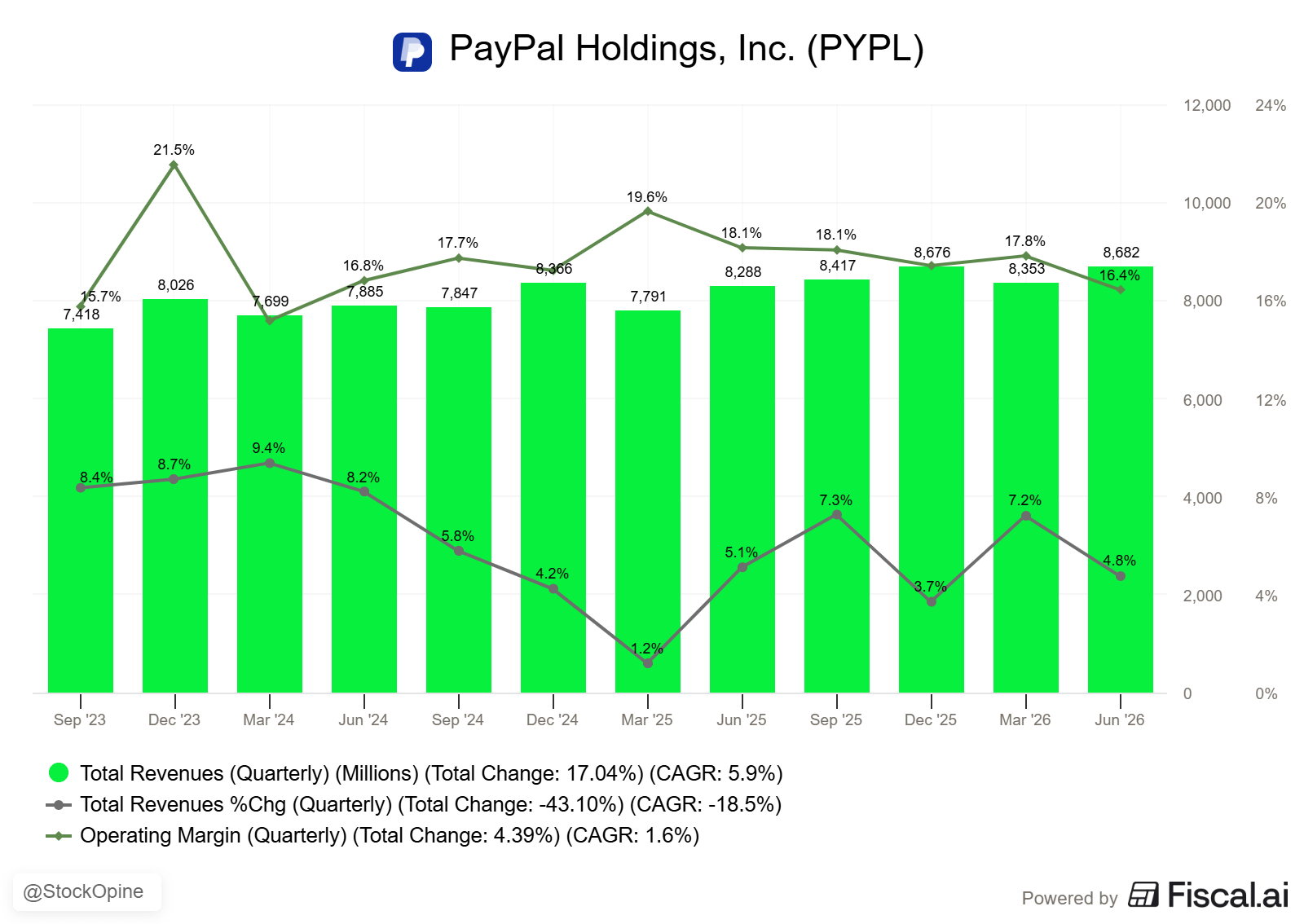
Net Revenues: $8.68 billion, up 5% on a spot basis and 3% currency-neutral (FXN).
Non-GAAP Operating Income: $1.5 billion, representing an 8% year-over-year decline.
Non-GAAP Operating Margin: Contracted 248 basis points to 17.4%. This is a further deterioration from the 18.5% operating margin we saw in Q1’26.
Non-GAAP EPS: $1.38, declining 1% year-over-year.
Transaction Margin Dollars ($TM): The core profit metric of the company grew just 1% to $3.9 billion. Excluding interest on customer balances, $TM grew 3% to $3.6 billion.
The core issue this quarter was the cost structure. Non-transaction related expenses jumped 9% to $2.39 billion. Management attributed this to intentional investments in platform modernization, cloud migration, and co-marketing to support Branded Checkout. Indeed technology and development costs grew by 10% YoY and 6.8% QoQ.
CFO Jamie Miller framed this cost increase as a timing mismatch, noting that they are investing ahead of the $1.5 billion in gross run-rate savings expected over the next 2 to 3 years.
“It’s important to note that part of the increase is timing. We’re investing ahead of cost savings that we expect to become more material in the fourth quarter.” - Jamie Miller, CFO
Source: Fiscal.ai (affiliate link with a 15% discount for StockOpine readers)
2. Payment Volume & Operating Metrics
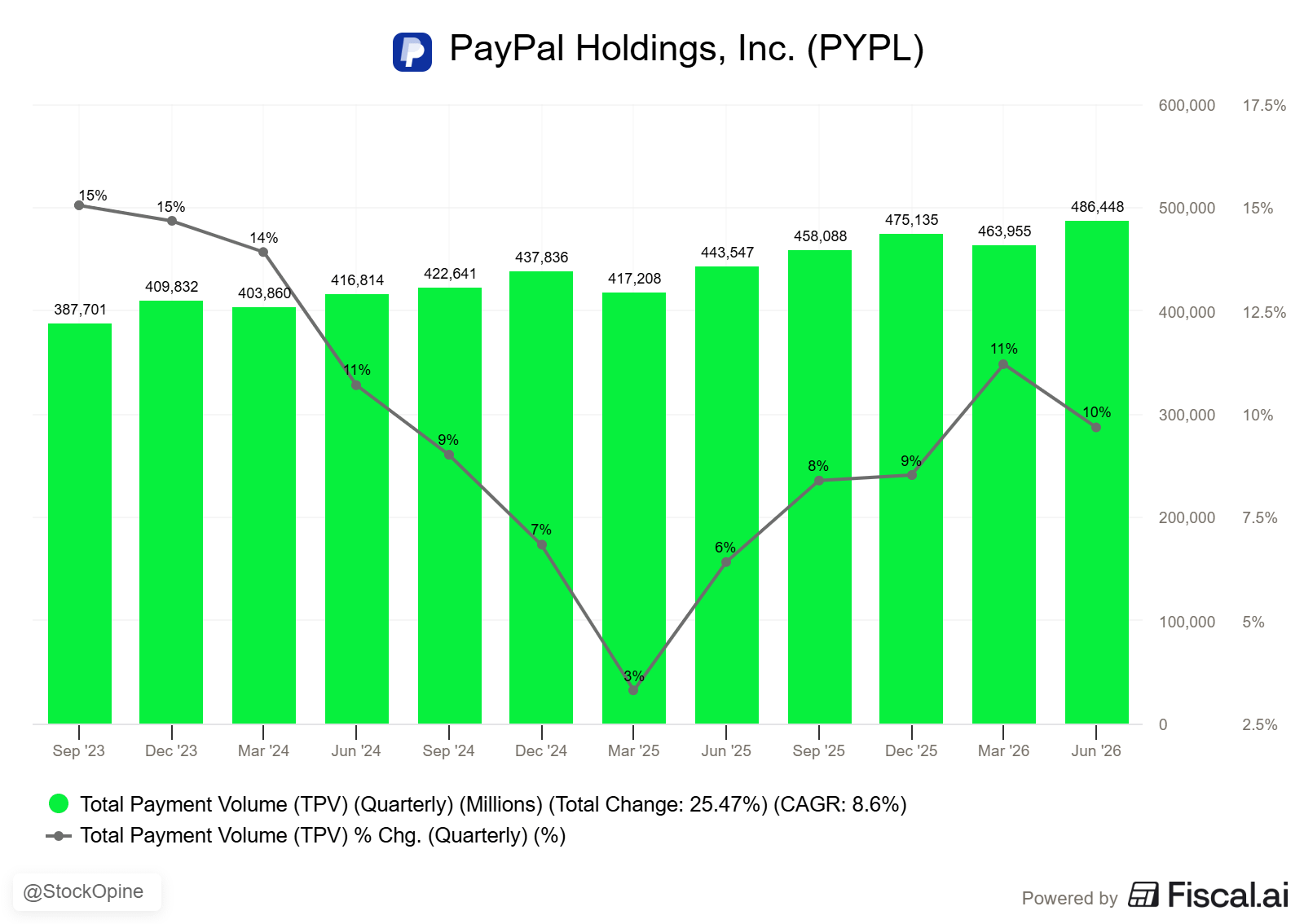
Total Payment Volume: TPV reached $486.4 billion, growing 10% spot and 9% FXN. Growth was heavily skewed toward the US market, where TPV increased 14%, driven by PSP, Venmo, and branded experiences. International TPV, however, was flat (0% FXN), with management pointing to persistent macroeconomic softness and intense local competition in Europe, particularly in travel and Germany.
Source: Fiscal.ai (affiliate link with a 15% discount for StockOpine readers)
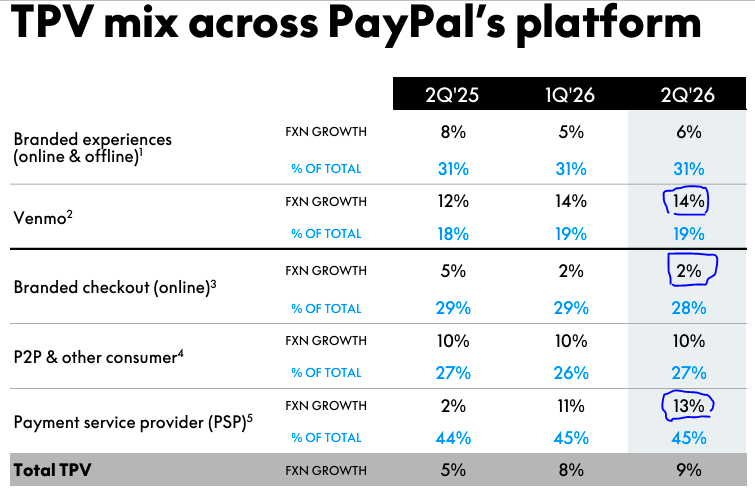
Branded Checkout: Branded Checkout TPV growth stabilized at 2% FXN for the second consecutive quarter. While management was eager to highlight this stabilization, driven by BNPL surging 26%, a 2% growth rate in a digital payments market expanding much faster implies ongoing market share bleed.
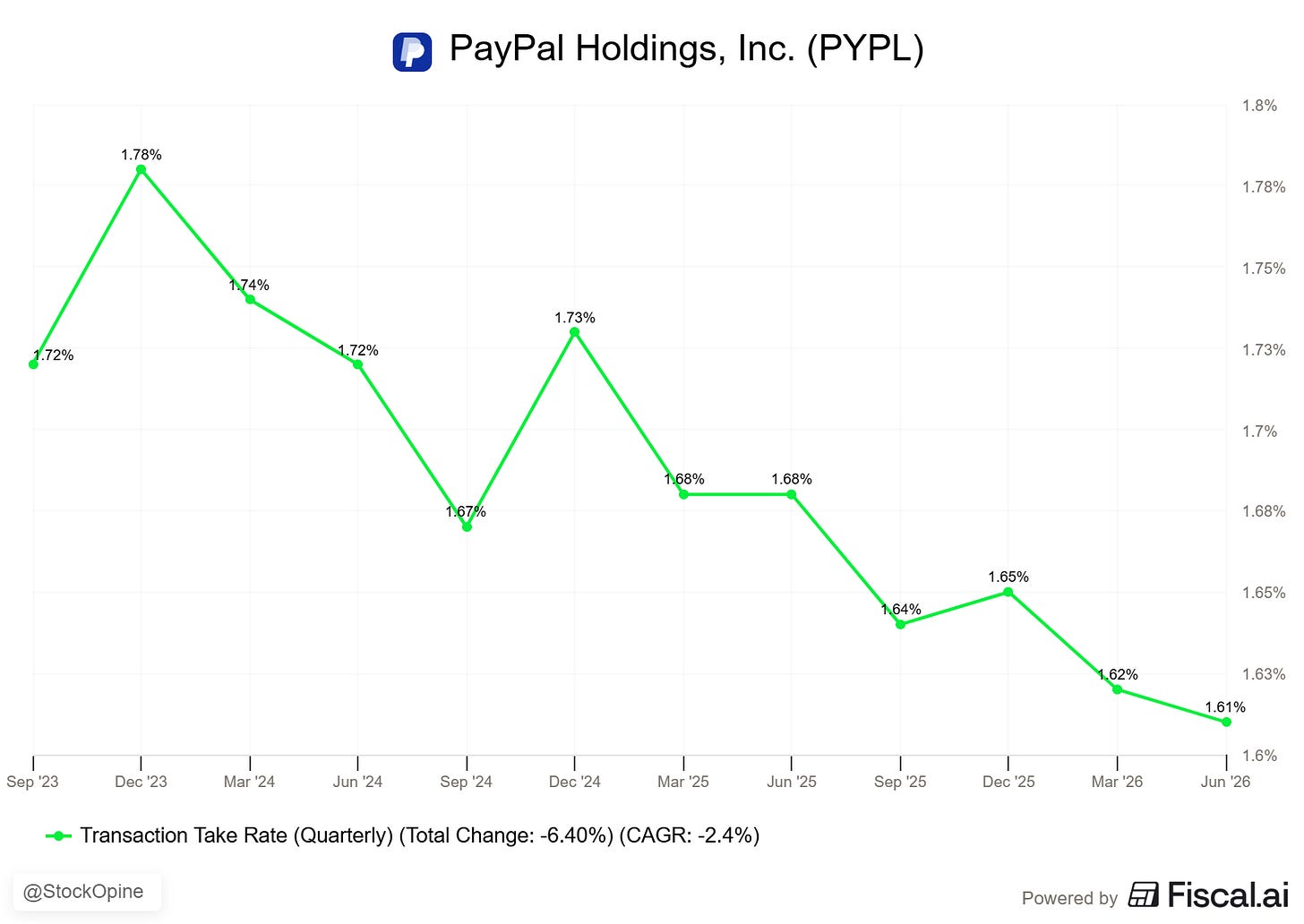
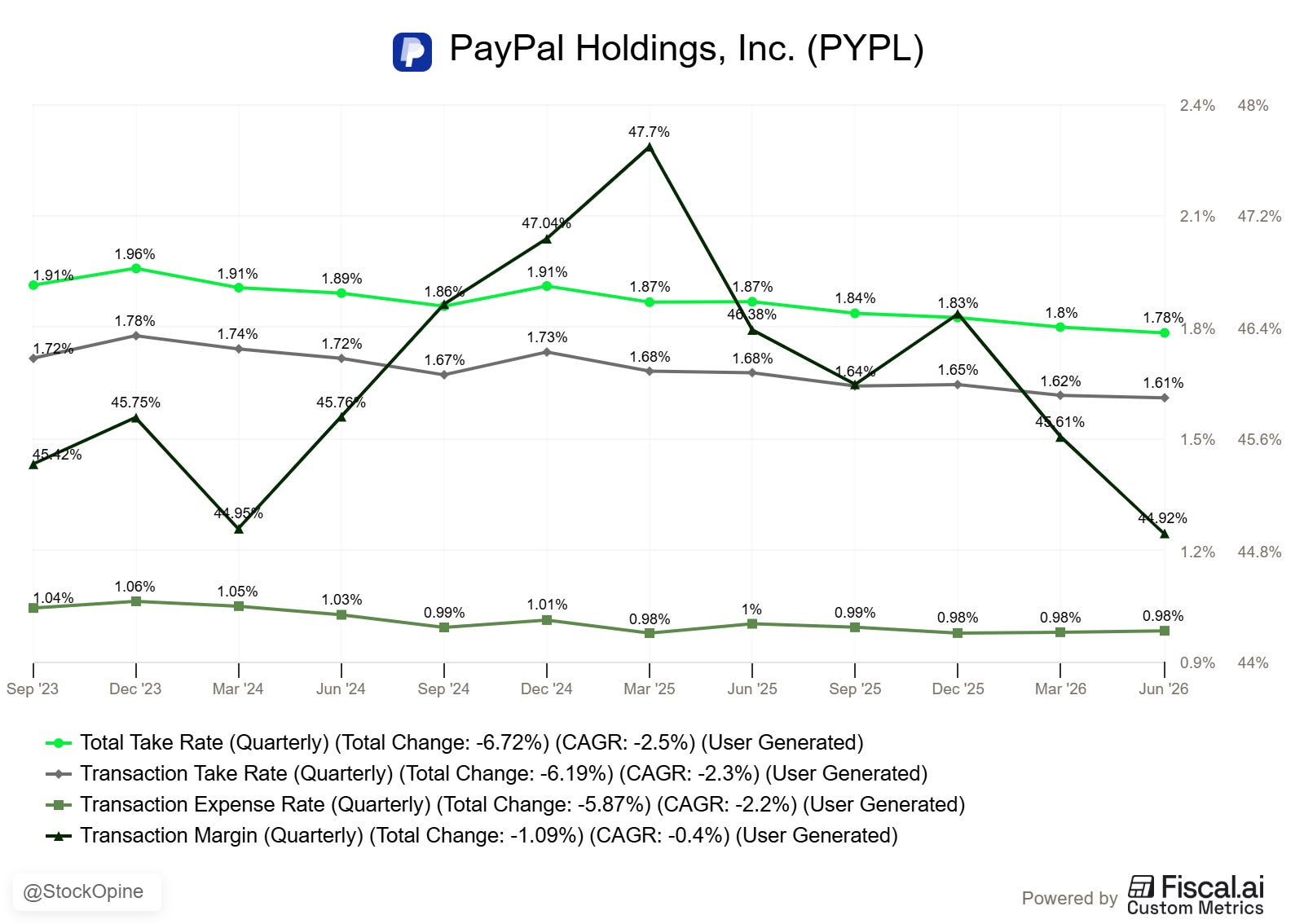
Staying flat is costing them money. The transaction take rate declined 7 basis points to 1.61%, driven by branded co-marketing investments and rewards as well as the growth in BNPL. They are effectively buying this stabilization.
Source: Fiscal.ai (affiliate link with a 15% discount for StockOpine readers)
Venmo and Enterprise: Once again, the lower-margin processing and Venmo did the heavy lifting.
PSP (Unbranded): TPV accelerated to 13% FXN, up from 11% in Q1’26. Within this segment, Braintree grew in the mid-teens, driven by profitable front book business and strong retention.
Venmo: TPV grew 14% FXN to $93.8 billion, marking its seventh consecutive quarter of double-digit expansion.
Venmo is evolving beyond a simple P2P transfer app. Monthly active accounts (MAAs) for the Venmo debit card grew over 50% year-over-year (60% in the previous quarter, yet still impressive). Users engaging with both the debit card and “Pay with Venmo” generate 9x higher average revenue per account (ARPA) than P2P-only users.
Additionally, in the US, Pay with Venmo TPV grew by 44%, far exceeding management’s expectations. These levers put together make Venmo a unique asset in PayPal’s stack. At the same time, they show the widening gap between the legacy high-margin checkout button and the lower-margin Venmo and enterprise processing arms.
Source: PayPal Earnings presentation Q2’2026
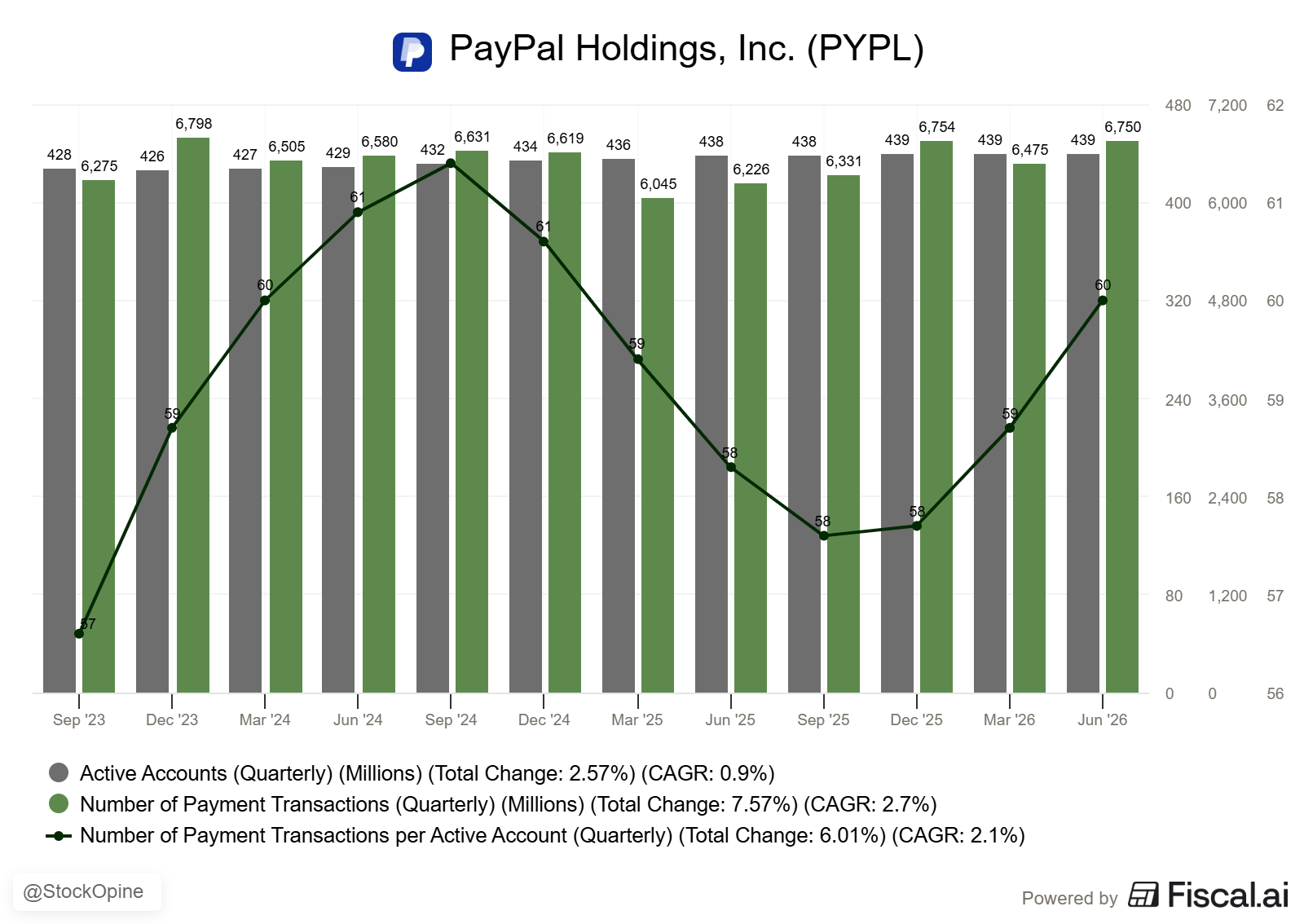
Active Accounts & Engagement: The user base remains stagnant. Active accounts ended the quarter flat year-over-year at 439 million, a sequential drop of 0.2 million accounts. However, the accounts that remain are highly engaged, aligning with Lores’ strategy to focus on high-value cohorts.
Account and activity metrics detail (Q2’26)
Active accounts: 439M (Flat Y/Y)
Monthly active accounts (MAA): 228M (+1% Y/Y)
Number of payment transactions: 6.75B (+8% Y/Y)
Number of payment transactions ex. PSP: 4.23B (+7% Y/Y)
Transactions per active account (TPA): 60.0 (+3% Y/Y)
TPA ex. PSP: 37.9 (+7% Y/Y)
Source: Fiscal.ai (affiliate link with a 15% discount for StockOpine readers)
e. Take Rates & Margins
Total Take Rate: 1.78% (down from 1.84% in Q2’25)
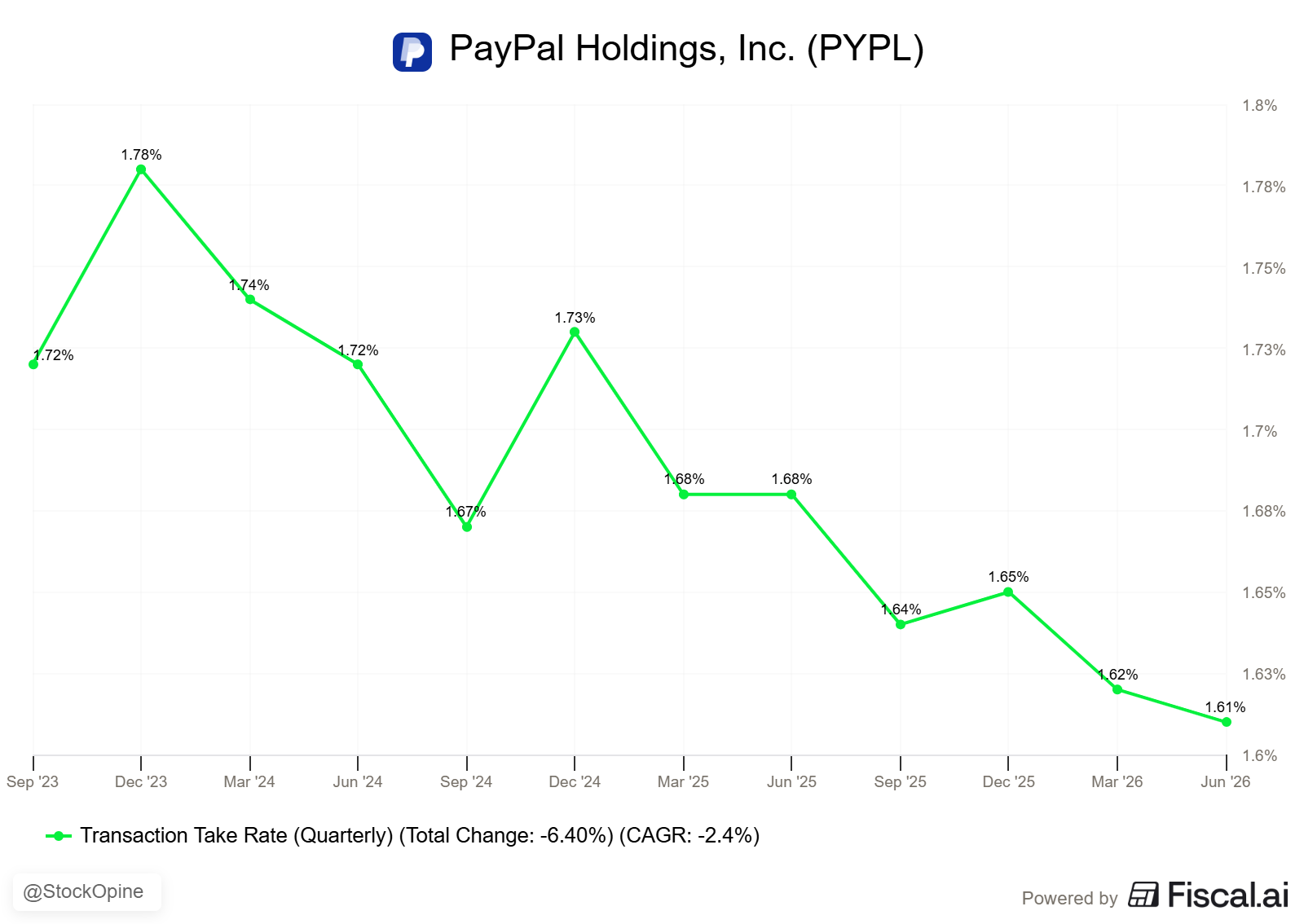
Transaction Take Rate: 1.61% (down from 1.68% in Q2’25)
Transaction Expense Rate: 0.90% (up slightly Y/Y due to Braintree mix shift)
Transaction Loss Rate: Improved by 2 basis points to 0.07%, reflecting better risk mitigation and fraud prevention.
Source: Fiscal.ai (affiliate link with a 15% discount for StockOpine readers)
3. Guidance & Capital Allocation
Management raised full-year expectations, but the drivers behind the raise require evaluation.
FY’26 $TM: Expected to reach ~$15.6 billion (~$14.5 billion excluding interest).
FY’26 Non-GAAP EPS: Raised to ~$5.38.
Q3’26 $TM: Expected to be “slightly positive”.
The EPS raise is affected by capital allocation as PayPal executed $1.5 billion in share repurchases in Q2. On a trailing 12-month basis, they have retired $6.0 billion in stock, reducing weighted average shares by 10%. When net income is down 12.5% but GAAP EPS is only down 3%, financial engineering is hiding the underperformance.
Management also expects a restructuring related charge of $120 to $140 million in the second half of 2026 as they execute the first phase of their $1.5 billion cost-cutting plan. They are targeting $400 million in run-rate savings by the end of this year. If those savings fail to materialize in Q4, then we have a serious problem and a company with a structural decline.
4. Analyst Q&A Highlights
The Q&A session revealed skepticism regarding the turnaround story.
Tien-Tsin Huang (JPMorgan): Pushed Enrique Lores on M&A speculation. While Lores used standard corporate wording, he left the door open, stating: “If we see levers or a path that we believe would create superior value for our shareholders than executing our current strategy, we will, of course, carefully consider them”.
When a new CEO acknowledges a willingness to consider structural alternatives on his second earnings call, it signals the difficulty of the road ahead.
Dan Perlin (RBC): Questioned Branded Checkout outside the US, asking if the weakness was structural or macro-driven. Jamie Miller blamed normalization in European growth and pressure in the travel vertical, but admitted to increased competition.
Sanjay Sakhrani (KBW): Asked why investors should have confidence these new investments will play out when prior PayPal strategies failed to materialize. Lores pointed to the expansion of financial services (already ~20% of $TM) and the acceleration of Venmo and PSP as tangible proof points. It remains to be seen but we are sceptical as well.
5. Conclusion
PayPal Q2 2026 was mixed but the margin compression proves that it is expensive to protect share in Branded Checkout which is bleeding. The bull case relies on the promised $1.5 billion in gross cost savings to offset today’s aggressive non-transaction OpEx investments. If the savings fall short and if Branded Checkout deceleration resumes once the co-marketing fade, then there is a deadlock.
The leadership team is trying to execute a logical strategy, but defending market share is proving highly dilutive. Until operating leverage returns, PayPal remains a show-me story.
A quick note on our position: If Stripe were to make an improved bid for PayPal, we view $75 as an attractive exit point. Alternatively, our ideal outcome remains a spin-off of Venmo, at which point we would look to exit the legacy core and hold strictly Venmo.
Separately, we have shared our notes on Greggs’ stellar earnings and Fortinet’s latest report for you to have a look. If you want us to unpack either of these in greater detail, let us know below.